
by Franco Jose Barona, Manila Times
June 26, 2026
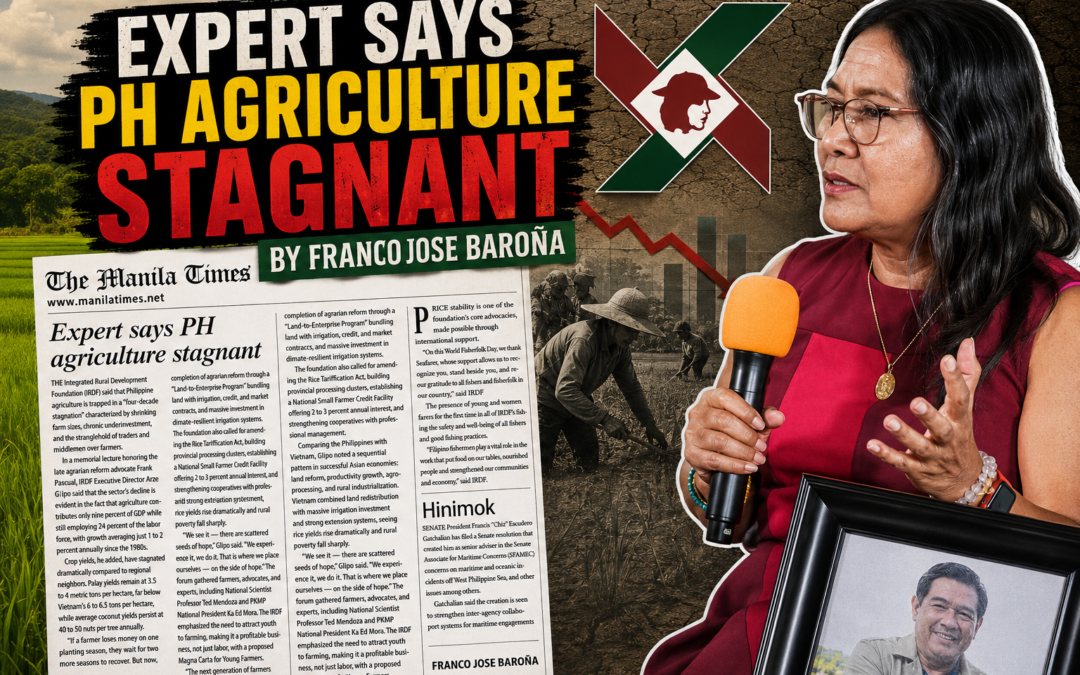
The Integrated Rural Development Foundation (IRDF) said that the Philippine agriculture is trapped in a “four-decade stagnation” characterized by shrinking farm sizes, chronic underinvestment, and the strangehold of traders and middlemen over farmers.
In a memorial lecture honoring the late agrarian reform advocate Frank Pascual, IRDF Executive Director Arze Glipo said that the sector’s decline is evident in the fact that agricultyre contributed only nine percent of GDP while still employing 24 percent of the labor force, with growth averaging just 1 to 2 percent annually since the 1980s.
Crop yields, he added, have stagnated dramatically compared to regional neighbors. Palay yields remain at 3.5 to 4 metric tons per hectare, far below Vietnam’s 6 to 6.5 tons per hectare, while average coconut yields persis at 40 to 50 nuts per tree annually.
“If farmer loses money on one planting season, they wait for two more seasons to recover. But now, losses come one after another – palay prices drop, coconut prices drop, and then suddenly a super typhoon hits. It takes tree harvests for them to get back on their feat,” Glipo said, illustrating the devastating cycle that keeps farmers perpetually in debt.
Citing IRDF’s analysis, Glipo identified interconnected barriers preventing agricultural transformation. After nearly four decades, Comprehensive Agrarian Reform Program (CARP) implementation remains unfinished, with average farm size shrinking from 3.0 hectares in 1980 to just 1.1 hectares in 2025. Market liberalization has seen the agricultural trade deficit balloon from $42 million in the 1980s to $11.06 billion in 2025, while the Rice Tarrification Act allowed imports that drove farm gate play prices to P12 per kilogram.
Agriculture receives only 2.5 to 3 percent of the national budget compared to the Food Agriculture Organization-recommended 10 percent, and rural areas remain “nothing but rice fields, nothing but coconut farms” without processing facilities. With 56 percent of farms under 0.5 hectares, mechanization remains impossible, while farmers borrow from traders at 20 to 30 percent monthly interest, creating a cycle of debt dependency.
“As we have been saying, why is it that the farmers who saved and paid to build Coco Levy fund are not the ones benefitting, rather corporations and government agencies – it never went directly to them,” Glipo said, referring to the decades-old coconut levy issue.
The IRDF noted that many agrarian reform beneficiaries received land but lacked irrigation, farm-to-market roads, extension services, and post harvest facilities – producing what scholars call “land reform without rural transformation.” “We refuse to accept the status quo where our farmers have been suffering for four decades. Yet nothing seems to change in their situation. We do not want this to continue,” Glipo said.
The IRDF proposed a comprehensive reform agenda to break the cycle, including farmer-controlled marketing systems with public floor-price procurement, completion of agrarian reform through a “Land-to-Enterprise Program” bundling land with irrigation credit, and market contracts, and massive investment in climate-resilient irrigation systems.
The foundation also called for amending the Rice Tarrification Act, building provincial processing clusters, establishing a National Small Farmer Credit Facility offering 2 to 3 percent annual interest, and strengthening cooperatives with professional management.
Comparing the Philippines with Vietnam, Glipo noted a sequential pattern in successful Asian economies: land reform, productivity growth, agro-processing , and rural industrialization. Vietnam combined land redistribution with massive irrigation investment and strong extension systems, seeing rice yields rise dramatically and rural poverty fall sharply.
“We see it – there are scattered seeds of hope,” Glipo said. “We experience it, we do it. That is where we place ourselves – on the side of hope.” The forum gathered farmers, advocates and experts, including National Scientist Professor Ted Mendoza and PKMP National President Ka Ed Mora. The IRDF emphasized the need to attract youth to farming, making it a profitable business, not just labor, with a proposed Magna Carta for Young Farmers.
“The next generation of farmers should no longer have to endure this kind of suffering,” Glipo said.#