
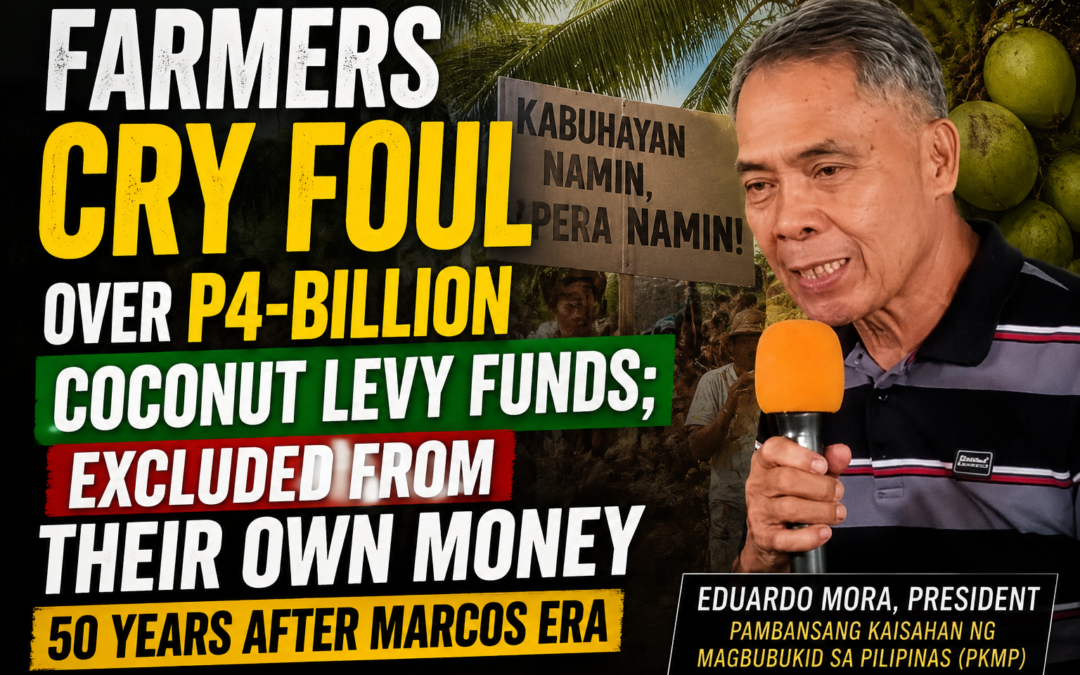
Farmers’ Own Money Still Out of Reach; Only 3.5% Registered to Benefit
In a scathing testimony before a Senate hearing, the president of the Pambansang Kaisahan ng Magbubukid sa Pilipinas (PKMP), Eduardo Mora, laid bare a decades-old injustice: the billions of pesos forcibly collected from coconut farmers through the Coconut Levy fund remain largely inaccessible to them, controlled instead by government agencies and corporate giants. Delivering a historical account that traces the roots of the agricultural crisis back to the Marcos regime in 1972, Mora revealed that despite the passage of Republic Act 11524 in 2021, farmers are still excluded from managing their own money.
“It is legalized theft,” Mora declared, emphasizing that the automatic deduction of 0.60 centavos per kilo of copra—money intended for farmer development—never reached the intended beneficiaries. Instead, it was funneled to cronies, holding companies, and now, big businesses.
THE CURRENT SCANDAL: P4 Billion to San Miguel, Farmers Left Out
According to Mora in IRDF forum “Confronting the Crisis in Philippine Agriculture,” in Felicidad Restaurant, the implementation of the Coconut Levy trust fund under the current administration has been a continuation of historical injustices. Shortly after the law was passed, P4 billion (84% of the fund) was immediately given to San Miguel Corporation. The remaining funds were distributed among government agencies including the DPWH, TESDA, DBM, and the Treasury.
Mora highlighted that farmers are completely absent from the trust fund committee that oversees their own money. “The Treasury, DBM, and the PCA know where the money is, but the farmers do not. We are not included in the trust fund committee. We don’t know where our money is being used,” he lamented.
The result of this exclusion is a bureaucratic maze that prevents farmers from benefiting. Requirements for access include being registered in the coconut farmer registry and being a member of a cooperative. However, Mora noted that only a dismal 3.5% of coconut farmers are actually registered, effectively disqualifying the vast majority from ever seeing a cent of the levy they paid.
FAILED PROMISES: RA 11524 and the Betrayal of Farmers
While the passage of RA 11524 during the Duterte administration was initially hailed as a victory—a promise made by the then-president to return the levy to farmers—Mora testified that the law was a “false promise.” The version that passed Congress and the Senate was not the farmers’ proposal but rather a version crafted by landlords, capitalists, and political cronies.
Mora revealed that initially, 99% of senators expressed support for the farmers’ cause. However, when the bill reached the bicameral conference committee, they faced resistance. He said the committee warned them that if they pushed for the farmers’ version in the plenary, they would lose. When the law was finally approved, farmers were excluded from crafting the Implementing Rules and Regulations (IRR).
“They said we didn’t need to be included in the trust fund because we ‘don’t understand money.’ We were told we should be thankful we weren’t included. That is not just—we are the ones who contributed the money,” Mora said, quoting sentiments from some legislators, including Senator Villar, who questioned the farmers’ capability to handle financial matters.
HISTORICAL CONTEXT: The Marcos Era and the Birth of the Crisis
Mora traced the origin of the current crisis to September 1972, when President Ferdinand Marcos declared Martial Law and initiated a “New Society.” He argued that agriculture began its steady decline under Marcos.
- Land Reform (PD 27): Marcos’s land reform program only covered rice and corn lands. It deliberately exempted large sugar, coconut, and corporate plantations—which were owned by his cronies. Poor farmers were left with tiny plots, while the elite kept their vast estates.
- Masagana 99: The “Masagana 99” program appeared to help rice farmers but was designed to enrich international and local capitalists. Instead of promoting organic farming, it made farmers dependent on imported fertilizers controlled by businessmen. 99% of the profit from agricultural inputs went to capitalists, not farmers. After harvest, farmers were left with nothing but debt.
THE COCONUT LEVY MECHANISM: How the “Legalized Robbery” Worked
The Coconut Levy was collected under the Philippine Coconut Authority (PCA) through a simple, brutal mechanism:
“When a farmer sold his copra, the buyer automatically deducted 0.60 centavos per kilo. That money went to the government and Marcos’s cronies.”
Mora noted that by 1986 alone, the accumulated funds had already reached billions—money that could have transformed the lives of poor farmers. Instead, Marcos placed the funds into 14 holding companies, including Coco Life Insurance.
What did the farmers get in return? Only two “development” programs:
- Scholarships requiring an 85% grade average (which most farmers’ children could not achieve).
- Insurance that paid a meager P15,000 only if the farmer died or suffered a permanent disability.
Mora challenged the logic sarcastically: “What kind of development is that? You only benefit if you’re dead or maimed.”
SYSTEMIC BARRIERS AND CONTINUING INJUSTICE
Today, even if a farmer is lucky enough to be registered, the system is rigged against them. The funds are not disbursed as direct aid or investment; instead, farmers must apply for loans with interest through training programs.
Mora elaborated on the absurdity: “We have to request training, but training every day or every week is not industry development. We have to borrow money with interest to access the training, but it’s our own money!”
The DPWH, which builds roads under the coconut levy fund, has no bearing on the farmers’ plight. “The DPWH benefits vehicle owners and businessmen. Farmers’ prices are still being suppressed, and there is no improvement in the coconut industry,” he asserted.
THE CORE DEMAND: Inclusion and Nationalism
Mora laid out the farmers’ simple yet fundamental demands, which have been consistently ignored for five decades:
- Representation: A seat for farmers on the trust fund committee alongside the government to ensure transparency.
- Development: A dedicated office under the President focused solely on the coconut industry, from local processing to the international market.
- Inclusivity: No stringent grade requirements for scholarships—all farmers’ children should have access.
He concluded with a stark warning for current and future leaders: “From Marcos’ time until now, whoever is president, as long as the structural culture doesn’t change, the situation won’t change. This is the crisis of agriculture in the Philippines—farmers are excluded, and our money is stolen by the very government that is supposed to protect us.”
ANALYSIS: A 50-Year Wound Unhealed
Mora’s testimony paints a grim picture of a perpetually broken system. The Coconut Levy, a historic injustice born from the dictatorial regime of Ferdinand Marcos, has not been rectified by subsequent administrations. Instead, the money continues to circulate among political elites and corporations, while the coconut farmers—the poorest of the poor—remain marginalized.
With only 3.5% of farmers registered, the promise of RA 11524 has become a phantom. Mora challenged senators to demonstrate true nationalism: “If our senators think like true Filipinos, prioritize farmers, and stop stealing, then we will believe in the law. But for now, the money is gone—it has been stolen twice.”
Mora is now calling for the full intervention of the Senate to correct the IRR and ensure farmers are finally included in the management of the Coconut Levy trust fund—before the money runs out entirely.#