
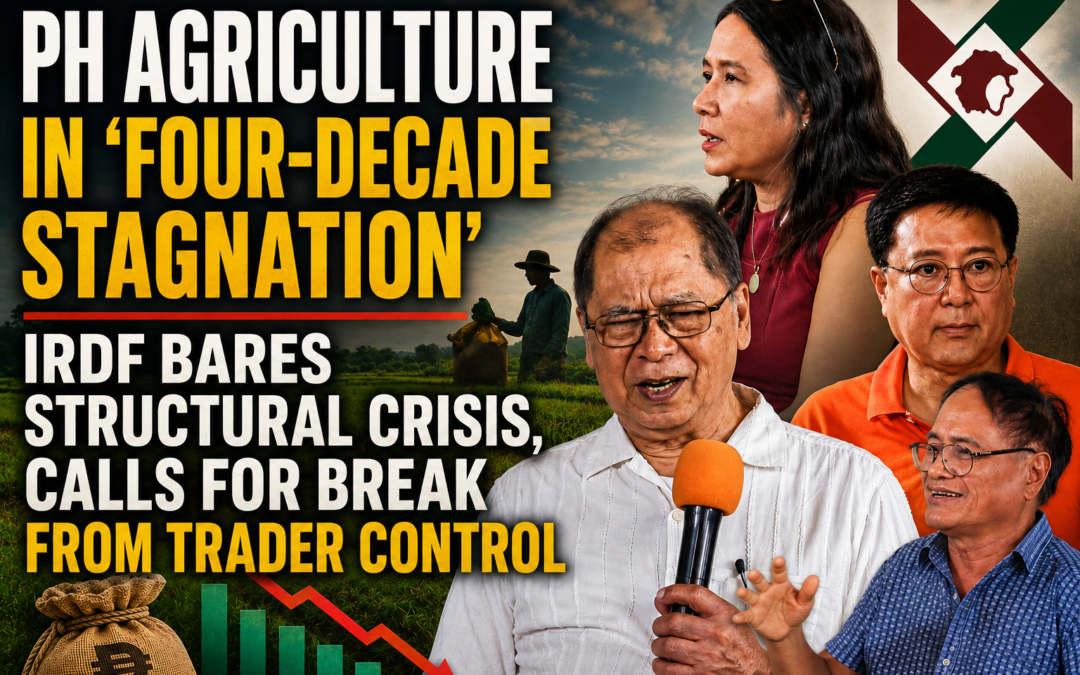
The Philippine agriculture sector remains trapped in a “four-decade stagnation” characterized by shrinking farm sizes, chronic underinvestment, and the stranglehold of traders and middlemen over farmers, according to a comprehensive analysis presented by the Integrated Rural Development Foundation (IRDF).
In a memorial lecture honoring the late agrarian reform advocate Frank Pascual, IRDF Executive Director Arze Glipo painted a grim picture of the sector’s decline: agriculture sector contributes around 9% of GDP in 2025, but still employs a huge chunk of the labor force at 24%, agricultural growth has averaged only around 1-2% annually over much of the period since the 1980s, there is limited mechanization and weak agro-industrial development. The growth in yield of major crops has stagnated with annual yield of palay at 3.5-4 metric tons compared to Vietnam’s 6-6.5 t/ha. Average yields of coconut remain at 40-50 nuts/tree/year.
“Kung malugi yung isang magsasaka sa isang taniman, maghihintay siya ng dalawang taniman ulit upang maka-recover. Pero ngayon, halos sunod-sunod ang pagkalugi—bagsak ang presyo ng palay, bagsak ang presyo ng niyog, at biglang may super typhoon. Magtatatlong anihan na ang kailangan niya upang makabangon,” Glipo said, illustrating the devastating cycle that keeps farmers perpetually in debt.
The Structural Barriers
Citing IRDF’s analysis, Glipo identified eight interconnected barriers preventing agricultural transformation:
- Concentrated market power of traders and intermediaries who control everything from seed supply to pricing, leaving farmers with only a small share of final consumer prices;
- Incomplete and uneven agrarian reform—after nearly four decades, CARP implementation remains unfinished, out of the 4.8 million hectares private agriculture lands covered by DAR, 1.4 million hectares remain under collective titles and average farm size has shrunk from 3.0 hectares in 1980 to just 1.1 hectares in 2025;
- Market liberalization opened Philippine markets to subsidized cheap food imports, with agricultural trade deficit ballooning from $42 million in the 80’s to $11.06 billion in 2025. The Rice Tariffication Act of 2019 dismantled regulation of rice imports allowing 4 million metric tons of rice to drive farmgate palay prices to P12/kg in 2025;
- Chronic underinvestment—agriculture receives only 2.5-3% of the national budget compared to the FAO-recommended 10%;
- Weak agro-industrialization—farmers supply raw materials but lack processing capacity, with rural areas remaining “puro palayan, puro niyugan” without factories or processing plants;
- Fragmented farm structure—7.4 million farms, with 56% under 0.5 hectares, making mechanization and economies of scale impossible;
- Weak cooperatives and farmer organizations that remain undercapitalized with poor governance;
- Rural finance failure—farmers borrow from traders at 20-30% monthly interest, creating a cycle of debt dependency.
The Human Cost
“Sabi nga natin, bakit naman ang magsasaka na siyang nag-ipon at nagbayad upang mabuo ang Coco Levy, pero ngayon ang nanginginabang ay mga korporasyon at government agencies—hindi naman napunta direkta sa kanila,” Glipo said, referring to the decades-old issue of coconut levy funds.
The IRDF noted that many Agrarian Reform Beneficiaries received land but lacked irrigation, farm-to-market roads, extension services, machinery, working capital, and postharvest facilities—producing what scholars call “land reform without rural transformation.”
Glipo emphasized:
“Ayaw nating tanggapin ang status na apat na dekada nang naghihirap ang ating mga magsasaka. Subalit parang walang nangyayari sa katayuan nila. Ayaw natin na magpatuloy ito.”
The Way Forward: Breaking the Cycle
The IRDF proposed a comprehensive reform agenda built on eight pillars:
- Break trader and middleman control by establishing farmer-controlled marketing systems with public floor-price procurement, farmer-owned logistics (trucks, warehouses, dryers), and direct working capital to cooperatives;
- Complete agrarian reform by securing titles, canceling exploitative leaseback arrangements, and creating a “Land-to-Enterprise Program” that bundles land with irrigation, machinery, credit, and market contracts;
- Massive irrigation investment, rehabilitating communal irrigation systems and shifting from large, slow, capital-heavy irrigation toward diversified and climate-resilient water systems through building small water impounding facilities, solar powered irrigation pumps, pipe distribution and other small to medium irrigation systems;
- Climate-resilient agriculture through a Climate Reparation and Agricultural Recovery Fund, automatic disaster payouts, and climate-resilient seed banks;
- Reverse liberalization by amending the Rice Tariffication Act, using safeguard measures when imports depress farmgate prices, and prioritizing food sovereignty;
- Agro-industrialization by building provincial processing clusters for rice (milling, drying, rice bran oil), coconut (oil, coir, biochar, VCO), fisheries (cold storage, canning), and vegetables (cold chain, dehydration);
- Public rural finance with a National Small Farmer Credit Facility offering 2-3% annual interest;
- Strengthen cooperatives and farmer associations with professional management, priority access to public procurement, and ownership of processing facilities.
Lessons from Vietnam and Hope for the Future
Contrasting the Philippines with Vietnam, Glipo noted that successful Asian economies followed a sequence: land reform, productivity growth, agro-processing, manufacturing, and rural industrialization. Vietnam, which combined land redistribution with massive irrigation investment, strong extension systems, and state-supported producer organizations, saw rice yields rise dramatically and rural poverty fall sharply.
The IRDF documents concluded that genuine agricultural transformation requires not just land redistribution, but “large-scale public investment, stronger farmer institutions, agro-industrialization, value-chain upgrading, and policies that shift market power toward producers rather than intermediaries.”
“Nakikita naman natin ‘yan—may mga pailan-ilang seeds of hope,” Glipo said. “Nararanasan natin ‘yon, ginagawa natin ‘yon. Doon tayo lumalagay sa may pag-asa.”
The forum, held at Felicidad Restaurant, gathered farmers, advocates, and experts including National Scientist Professor Ted Mendoza and PKMP National President Ka Ed Mora, who discussed ongoing struggles in the coconut sector. The IRDF emphasized the need to attract youth to farming, making it “a profitable business, not just labor,” with a proposed Magna Carta for Young Farmers.
Glipo’s closing message was clear:
“Ang susunod na henerasyon ng mga magsasaka ay hindi na dapat abutin ang ganitong paghihirap.”#