
Rights group warns of worsening floods, and urban heat amid climate crisis
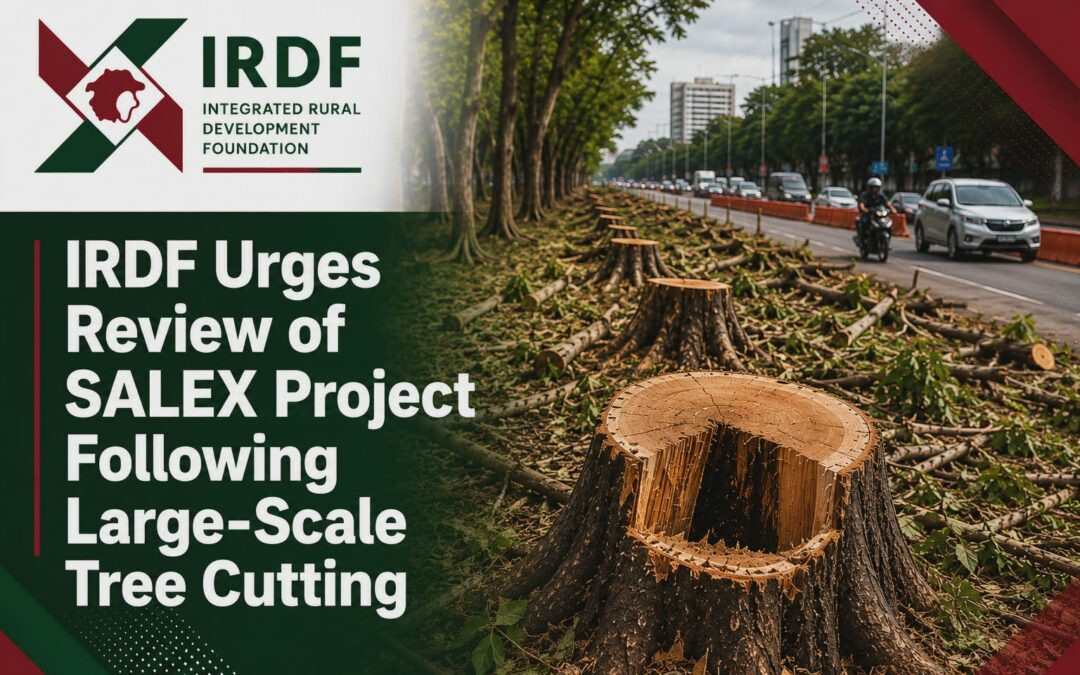
The Integrated Rural Development Foundation (IRDF), a national non-government organization established in 1989, has called for the immediate suspension and comprehensive review of the Southern Access Link Expressway (SALEX) Project following the cutting of hundreds of mature trees along Quirino Avenue in Manila.
The organization warned that the ongoing destruction of one of Manila’s remaining urban green corridors threatens environmental sustainability, public health, climate resilience, and the welfare of ordinary residents already vulnerable to extreme heat, flooding, and pollution.
According to permits issued by the Department of Environment and Natural Resources (DENR), a total of 617 trees has been authorized for cutting or relocation under the SALEX Project, a 40.65-kilometer elevated toll expressway network being developed by San Miguel Corporation (SMC) under a 30-year concession agreement. Reports indicate that more than 200 to nearly 300 trees have already been removed, including decades-old Narra trees estimated to be 35 to 40 years old.
“The destruction of mature trees in the middle of a worsening climate crisis is not sustainable development. Infrastructure must serve people without destroying the ecosystems that protect them,” IRDF Executive Director Arze Glipo said.
The SALEX Project, valued at approximately Php 152.39 billion, aims to connect Roxas Boulevard, Skyway Stage 3, and other major transport corridors through elevated expressway extensions, including the controversial Quirino Extension segment where the tree-cutting operations are concentrated.
While IRDF acknowledged the importance of improving public infrastructure and mobility, the organization stressed that development must not sacrifice ecological balance and community welfare.
“Development should strengthen climate resilience, not weaken it,” Glipo stated. “The removal of hundreds of mature trees will intensify urban heat, worsen flooding, reduce biodiversity, and diminish air quality in one of the country’s most densely populated cities.”
The affected trees along Quirino Avenue have long functioned as natural cooling systems, flood absorbers, carbon sinks, and habitats for birds and pollinating insects. Residents and small vendors in the area have already expressed concern over rising temperatures and the loss of shade following the initial clearing operations.
“Kasi wala na sisipsip kahit papaano,” one resident in a recent tv news interview, according to Glipo, referring to fears of worsening floods during the rainy season due to the loss of tree root systems that previously absorbed stormwater.
Another resident lamented the rapid disappearance of green spaces in the capital: “Wala nang punong maakyatan. At wala nang hanging mararamdaman dahil mainit na.”
IRDF emphasized that environmental degradation disproportionately affects marginalized communities, including informal workers, commuters, urban poor families, women, and children who are most exposed to climate-related risks.
As an organization engaged in policy advocacy on food security, food sovereignty, agrarian reform, and climate justice, IRDF underscored that ecological destruction and social inequality are deeply interconnected.
“Climate justice is social justice,” Glipo said. “Urban ecological destruction directly affects health, food systems, livelihoods, and the quality of life of vulnerable communities.”
The organization also raised concerns regarding transparency and accountability in the implementation of the SALEX Project. Glipo noted that the project proceeded through the franchise framework of the Philippine National Construction Corporation (PNCC) under Presidential Decrees 1113 and 1894, without undergoing a conventional public bidding process.
“For projects of this scale and environmental impact, transparency and meaningful public participation are essential,” Glipo stressed. “Communities deserve full disclosure of the environmental, social, and long-term economic consequences of infrastructure projects that will permanently alter their surroundings.”
IRDF acknowledged the recent decision of DENR and SMC to temporarily suspend tree-cutting activities for further technical review following public criticism and growing environmental concerns. The organization likewise recognized efforts by the local government of Manila to identify relocation areas for some of the affected trees and explore additional planting sites.
However, IRDF maintained that replacement planting programs involving 50,700 seedlings cannot immediately replace the ecological value of mature trees that have stood for decades.
“A 40-year-old tree cannot simply be replaced by a seedling,” the IRDF Executive Director said. “The environmental services provided by mature trees — including cooling, flood mitigation, carbon absorption, and biodiversity support — take decades to recover.”
The organization also questioned the practicality of the DENR’s replacement planting commitment under Memorandum 2012-02, which requires the planting of 100 seedlings for every naturally growing tree cut.
“Saan itatanim ang mga punong ito kung patuloy namang nababawasan ang mga berdeng espasyo sa lungsod?” Glipo asked, echoing concerns raised by residents over the limited availability of viable planting areas in highly urbanized Manila.
IRDF is now calling on the DENR, Toll Regulatory Board (TRB), San Miguel Corporation, and concerned government agencies to implement the following urgent measures before any tree-cutting activities resume:
- Conduct a transparent and independent environmental review of the SALEX Project, including cumulative climate and social impacts;
- Publicly disclose all Environmental Impact Assessments (EIA), engineering alternatives, and mitigation measures related to the project;
- Reevaluate the project alignment and engineering design to maximize the preservation of mature trees and existing green corridors.#