
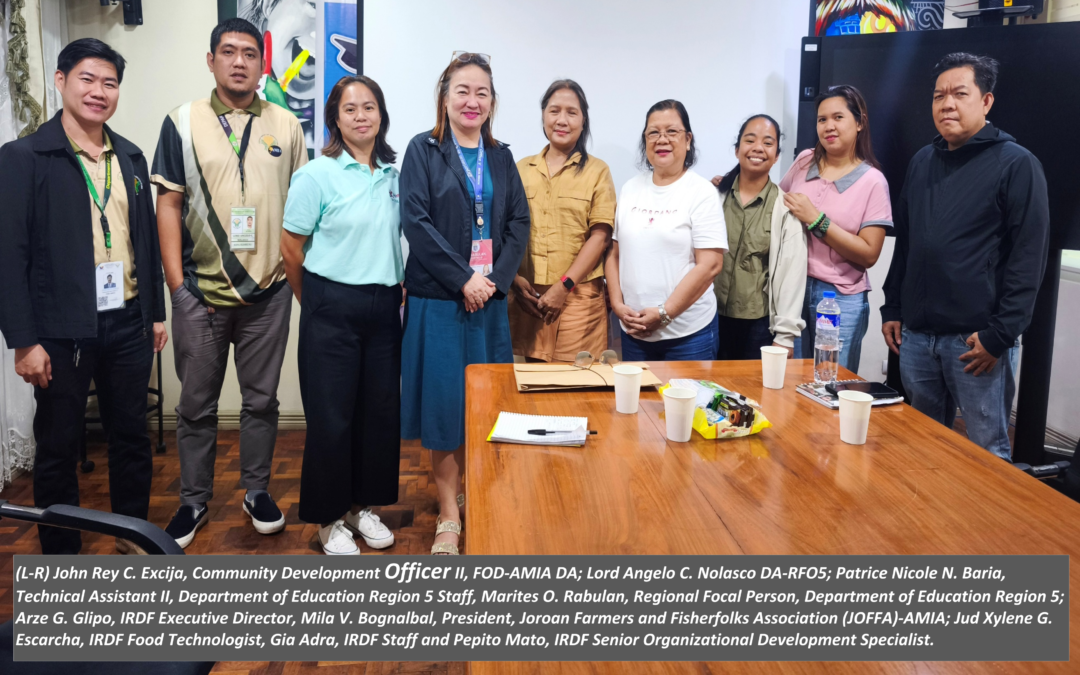
The Integrated Rural Development Foundation (IRDF) Executive Director Arze G. Glipo is advancing efforts to connect agricultural producers from Adaptation and Mitigation Initiative in Agriculture (AMIA) Villages to the Department of Education’s (DepEd) School-Based Feeding Program (SBFP), opening a potential institutional market for locally produced agricultural commodities while supporting efforts to improve child nutrition.
The initiative was discussed during a coordination meeting on October 14, 2026, focused on establishing direct market linkages between AMIA Villages and DepEd’s Education Support Services Division (ESSD).
Under the proposed arrangement, qualified farmers’ and fisherfolk’s cooperatives and enterprises could supply fresh and processed agricultural products to public schools, providing AMIA producers with a more organized and potentially high-volume market for their climate-resilient agricultural products.
Ms. Marites Rabulan of DepEd-ESSD identified Negotiated Procurement under the Sagip Saka Act, or Republic Act No. 11321, as the preferred procurement method for the feeding program. This allows Schools Division Offices to purchase directly from qualified local farmers and fisherfolk without the usual public bidding process. Competitive public bidding remains an alternative when local cooperatives cannot meet volume, logistical, or certification requirements.
However, Rabulan said that the current fiscal year’s procurement has already concluded. AMIA cooperatives were therefore urged to prepare their documentary requirements before May 2027 to meet the requirements for the next academic cycle.
These include active registration or accreditation through the Department of Agriculture’s Farmers and Fisherfolk Enterprise Development Information System (FFEDIS), proof of capacity to handle and transport products safely, and a completed proposal detailing product specifications, supply volumes, and prices.
The meeting also reviewed the feeding program’s weekly food distribution schedule, consisting of three days of hot meals and two days of ready-to-eat nutritious products. Processed and ready-to-eat products supplied by AMIA Villages must be registered with the Department of Science and Technology–Food and Nutrition Research Institute (DOST-FNRI) to verify their nutritional values.
Among the agreed next steps are the verification of AMIA cooperatives’ legal documents and registrations, submission of products for nutritional profiling, and preparation of inter-SDO supply and purchase agreements.
For IRDF, the initiative highlights the importance of connecting agricultural development with institutional markets. By helping qualified farming communities prepare for procurement and meet food safety and nutritional standards, the effort could create more reliable market opportunities for local producers while contributing to the government’s school nutrition objectives.#