
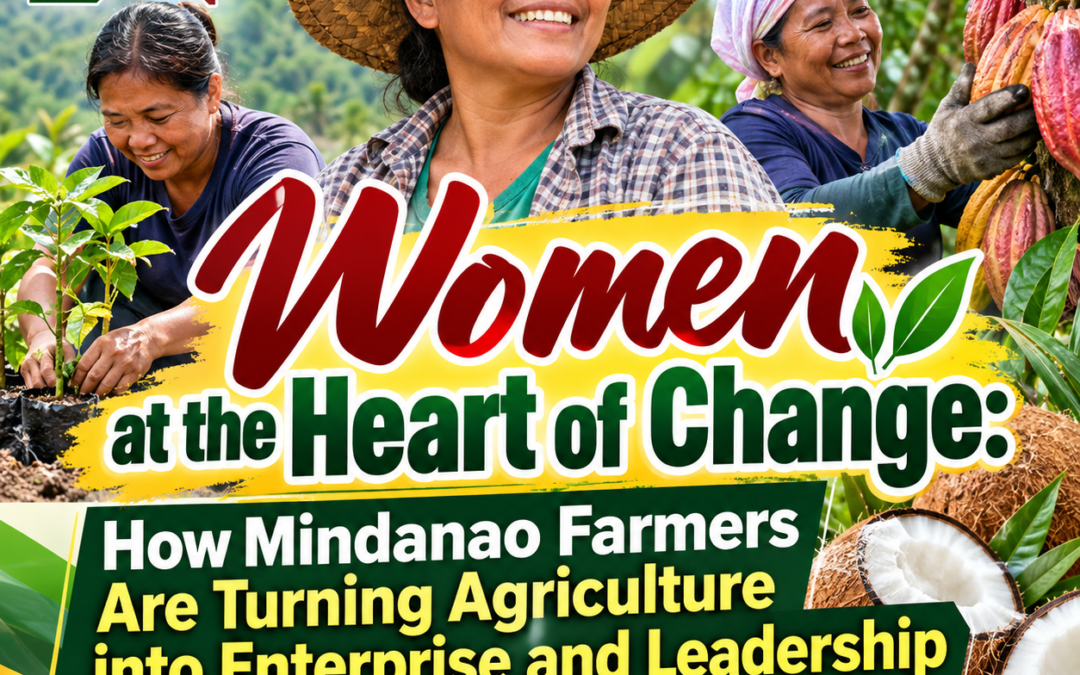
DAVAO REGION — From managing diversified farms to leading cooperatives and building community enterprises, women farmers in Mindanao are showing that agriculture can be more than a means of survival—it can become a pathway to economic independence, stronger leadership and community development. The experiences of farmer-leaders Shirley Sedenio, Alina Ombrosa, Lulin Ormo and Judith Tanimoco illustrate how training, organization and access to livelihood opportunities are helping women take a more active role in farming, business and decision-making.
Their stories reflect the women empowerment advocacy of the Integrated Rural Development Foundation (IRDF), which seeks to strengthen grassroots women’s economic participation, leadership and independence through sustainable agriculture, enterprise development, financial and entrepreneurial skills, and stronger participation in farmers’ organizations and community governance.
Shirley Sedenio: Turning a family farm into an agribusiness
For Shirley Sedenio of Brgy. Poblacion, Kiblawan, Davao del Sur, empowerment has taken root in a four-hectare farm.
A farmer for 34 years, Sedenio grows around 400 coconut trees, 1,500 cacao trees and 1,800 banana plants. She works with her husband in planting, weeding and fertilizing, but also handles much of the farm’s finances and participates in decisions involving production and the use of funds.
Her participation in seminars and training conducted by the Philippine Coconut Authority (PCA) and IRDF helped change the way she viewed farming. Instead of relying primarily on coconut, she adopted intercropping with cacao and banana, allowing the family to make better use of their land and diversify their potential sources of income.
“Through the trainings, I learned that farming should not depend only on one crop.”
Sedenio said she began looking at the farm as a business—monitoring production expenses, managing income and reinvesting earnings into farm operations.
“I now treat our farm as a business. We plan, we manage expenses, and we reinvest earnings.”
According to her testimony, diversified farming contributed to increased and more varied income, improved food availability, better land utilization and stronger farm and financial planning. Income from farming also helped finance the education of her four children, all of whom completed their studies.
Her role extends beyond her own farm. As a leader of the San Pedro Small Coconut Farmers Association, Sedenio participated in a community consultation with IRDF’s ASD Coconut Field Project in April 2025. Farmers identified problems including unstable farmgate prices, technical and technology gaps, weak support services, climate impacts and difficulty attracting young people to agriculture.
The association subsequently identified capacity building, direct marketing, cooperative enterprise development, environmental protection and stronger representation of farmers’ concerns among its priorities.
Alina Ombrosa: From OFW to woman farmer-entrepreneur
For Alina Ombrosa, agriculture offered a different path home.
The 56-year-old widow and mother of two from Brgy. Sinkatulan, Makilala, Cotabato spent about 20 years working in Kuwait and Saudi Arabia. Part of her overseas earnings went into acquiring a two-hectare coconut farm. After returning to the Philippines, she concentrated on developing the property into an integrated and diversified farming enterprise.
Today, her coconut farm is intercropped with cacao and banana, alongside vegetables and livestock. Her integrated farm includes 10 pigs and around 100 native chickens. Ombrosa personally manages and works on the farm while serving as Women President of the Sinkatulan Women Entrepreneurs Association under the SANVICOFA cluster.
Her approach goes beyond simply producing farm commodities. She practices value-adding and market-oriented production. Instead of selling pigs alive, for example, she processes and sells pork meat to obtain greater value. Her native chicken products are also marketed locally; her testimony lists dressed chicken at about ₱250 per kilo and eggs at ₱280 per tray of 30 pieces.
Perhaps the strongest measure of her transition is how she compares farming with her former life overseas. Ombrosa said her farm now provides income comparable to what she earned abroad while allowing her a less pressured life closer to home and nature.
Her experience demonstrates how savings accumulated abroad can be transformed into productive agricultural assets and how integrated farming and value-adding can turn a small farm into an enterprise rather than merely a source of subsistence.
GEMARCO: Women finding strength in numbers
The transformation is also happening collectively in Sta. Maria, Davao Occidental, where women dominate the membership and leadership of what is now the Guiang Estate Marketing Cooperative (GEMARCO).
The organization traces its roots to 1988, when the Department of Agrarian Reform awarded 63 farmworkers individual landholdings ranging from 1.5 to three hectares from the Guiang Estate in Brgy. San Isidro. The beneficiaries organized the Guiang Estate Agrarian Reform Beneficiaries Association or GECARBA, which later evolved into GEMARCO.
Yet land ownership did not automatically eliminate poverty. According to the project document, around 90 percent of households in the community remain below the poverty line, while farmers continue to confront low coconut income, unstable farmgate prices, lack of direct market access, limited support services, climate-related problems and declining interest among young people in agriculture.
Women, however, have emerged at the center of the cooperative’s response.
Of GEMARCO’s 68 members, 66 are women and only two are men. Many of these women previously had limited income opportunities and little control over economic resources, with some engaged largely in unpaid farm labor or small livelihood activities. Through organization and cooperative participation, the document says women increasingly became leaders, income earners and decision-makers.
Women President Lulin Ormo described organization as a turning point:
“Today, we are not only members—we are women leaders managing our own cooperative.”
Meanwhile, project manager Judith Tanimoco cited the cooperative’s social enterprises—including coconut consolidation and rice retailing—as providing members with market access and income while also strengthening her own skills and confidence in business management and organizational leadership.
GEMARCO is now looking toward livelihood diversification, including cassava, ube and breadfruit, while pursuing agricultural enterprises, sustainable farming practices and stronger organizational capacity to reduce farmers’ dependence on coconut alone.
Progress remains fragile
The women’s gains do not mean that the problems facing small farmers have disappeared.
Sedenio continues to confront rising fertilizer and input costs, fluctuating agricultural prices, pests and diseases, climate-related impacts and limited capital. She sees sustained training, coaching and mentoring, stronger markets for cacao and banana, value-adding, community enterprises and greater support for women’s agricultural leadership as necessary for further progress.
GEMARCO faces similar obstacles: inadequate operating capital, regulatory requirements, the challenge of learning cooperative business and copra trading, uncertain markets and production costs. Women leaders must also balance cooperative work with responsibilities at home.
These challenges highlight an important point emerging from the three documents: women’s empowerment in agriculture is not achieved through training alone. Skills must be accompanied by access to capital, markets, appropriate technology, functioning organizations and opportunities for women to participate in decisions that affect their livelihoods.
More than beneficiaries
IRDF’s stated approach is to promote women-led agribusiness and micro-enterprises while strengthening women’s access to skills, capital, cooperatives and sustainable agricultural practices. Its program also emphasizes leadership, organizational management, financial literacy, entrepreneurship and women’s participation in community decision-making.
The experiences of Sedenio, Ombrosa and GEMARCO’s women leaders put a human face on those objectives.
One woman diversified a four-hectare family farm and used its earnings to help educate four children. Another returned from two decades of overseas work and transformed her savings into an integrated agricultural enterprise. In another community, women who once struggled individually now make up nearly the entire membership of a cooperative seeking to build businesses and strengthen farmers’ bargaining power.
Their circumstances and achievements differ, but their experiences point toward the same lesson: rural women are not simply recipients of agricultural development. Given skills, organization and economic opportunities, they can manage farms, build enterprises, lead organizations and help shape the future of their communities #