
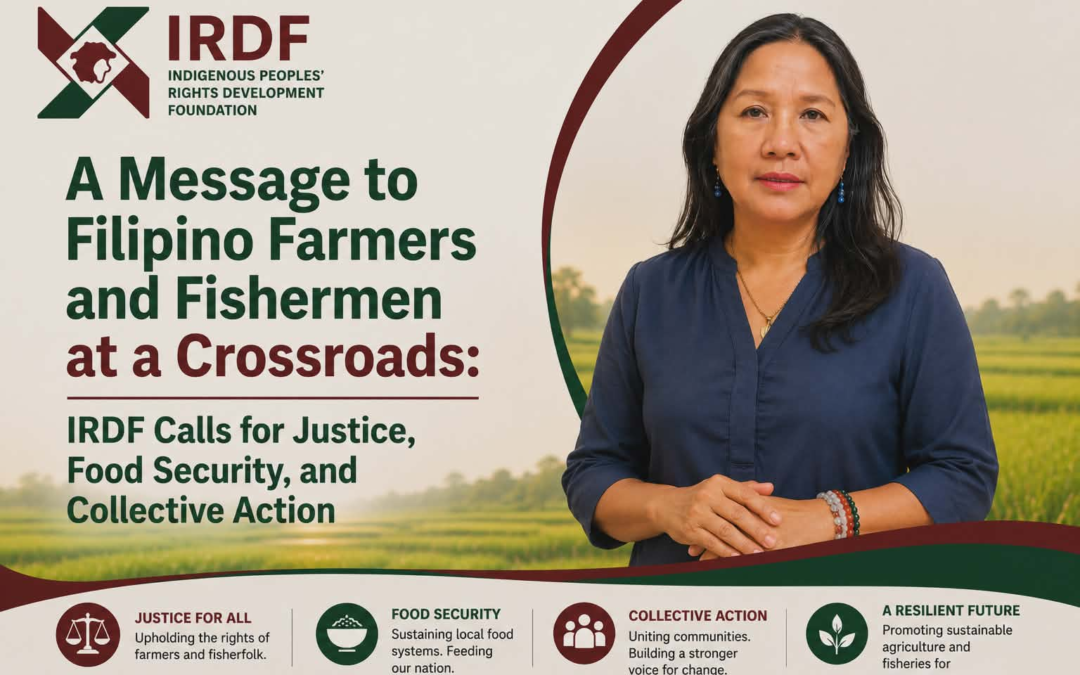
As global food systems buckle under the compounding pressures of climate change, fuel price volatility, and rising production costs, the Integrated Rural Development Foundation (IRDF) has issued an urgent and impassioned call to action: prioritize the nation’s farmers and fishermen, or risk the food security of over 100 million Filipinos.
In a compelling address, IRDF Executive Director Arze Glipo laid bare the deepening crisis facing the country’s agricultural frontliners, while rejecting narratives that blame farmers for high food costs. Instead, Glipo framed the issue as a fundamental struggle for justice, survival, and the right to life.
“No One Should Be Hungry Because of Our Food”
Glipo began by directly addressing the nation’s food producers—farmers and fishermen—affirming that they are not merely laborers but the primary consumers and guardians of the nation’s food supply.
“To our beloved citizens, also known as farmers, we at the IRDF are continuously advocating that we need to fight for our rights because we are the main consumers of food. No one should be hungry, no one should be poor because of our food.”
The IRDF, according to Glipo, remains steadfast in supporting farmers’ fights for fair prices on key commodities like rice, coconut, and yogurt—products that form the backbone of both local diets and rural economies.
Fishermen Caught Between Fuel Prices and Climate Shocks
Glipo painted a particularly grim picture for the country’s fishing communities, who face a double bind: volatile fuel costs and intensifying climate impacts.
“We know that the situation is getting worse because of the increase and decrease in the price of gasoline, which is our primary resource. Petroleum is our primary raw material.”
While fertilizer prices have seen a slight decrease, Glipo warned that production risks remain severe. The specter of climate change—stronger typhoons, erratic weather, and warming seas—has added an unpredictable and devastating layer to an already fragile livelihood.
“There is a huge risk in our production… the strong effect of climate change.”
A Call to “Not Let Go of Justice”
In the face of what Glipo described as an “increasingly worsening situation,” the IRDF executive director delivered a stirring message of resilience and moral clarity.
“It is up to you to continue to stand up, to continue to stand up for the rights of the farmers. Let us not let go of justice. Let us not let go of justice to fight for the rights of the farmers.”
Glipo emphasized that farmers and fishermen are the very reason the country has food on its tables. Their sacrifices—often invisible to urban consumers enjoying cheap rice—must be recognized and rewarded.
“You are the ones who ensure that there is food here. We have food here in our country. So, let us stand up for the farmers to be our priority now.”
With a population exceeding 100 million, the stakes could not be higher.
“We have seen in the crisis now that it is very important that we have food security because more than 100 million people are hoping that we will have enough food.”
Glipo struck a note of gratitude mixed with defiance, acknowledging the fatigue and sacrifice of farmers and fishermen while rejecting the notion that their hardship is inevitable.
“In the face of fatigue, in the sacrifice of our farmers and fishermen, it is fortunate that we have cheap food now. Let us fight this as citizens—for our right to food and our right to life for the farmers and fishermen.”
Partnerships Beyond the Public Sector
When asked whether the IRDF works with private sector partners, Glipo confirmed that collaborations exist, though they primarily involve international organizations, private companies, and environmental NGOs.
These partnerships have yielded tangible results, including reforestation efforts in protected areas supported by international environmental groups. In disaster response, the IRDF has mobilized local companies and a wide network of local associations to deliver relief goods during catastrophic events such as Super Typhoon Yolanda (Haiyan) and the super typhoons that devastated Bicol and Mindanao.
“We have many networks of local associations, and we are able to help them to bring relief goods to the communities.”
The Bottom Line
Glipo’s message is unambiguous: the path to genuine food security does not run through further exploitation of farmers and fishermen, but through justice, fair pricing, climate resilience, and collective citizen action. The IRDF continues to advocate, organize, and mobilize—but ultimately, Glipo insists, the fight belongs to all who eat.
“Let us stand up for the farmers to be our priority now.”