
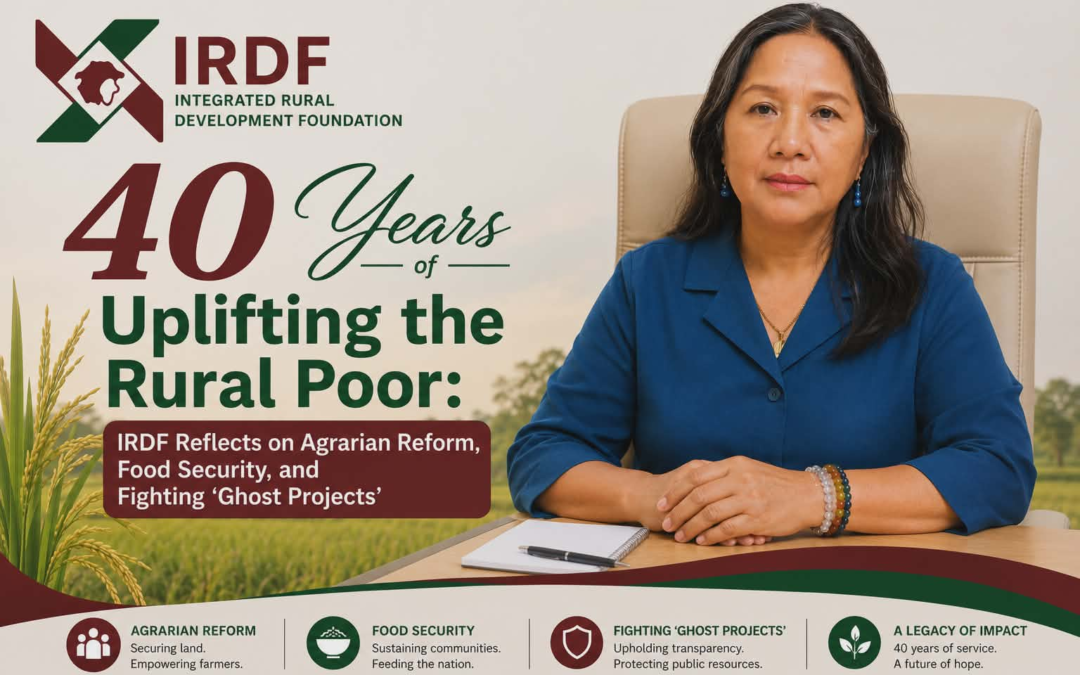
QUEZON CITY, Philippines – As the Integrated Rural Development Foundation (IRDF) approaches its 40th anniversary in 2029, its Executive Director, Arze Glipo, declares that while significant strides have been made in organizing over 30,000 rural Filipinos, the battle for genuine land reform and against corrupt, large-scale infrastructure projects is far from over.
“Ang mga rekurso—ang tubig, ang karagatan, ang lupa—sa paniniwala namin, dapat may kontrol ang mga mamamayan,” Glipo stated, emphasizing that these resources should not be exploited by real estate or mining companies at the expense of the poor.
‘Living Below the Poverty Line’: The Core Mission
Glipo described the harsh reality of the IRDF’s target communities. Despite decades of development, a majority of rural sectors remain trapped in hardship.
“Karamihan sa mga rural sectors natin ay mahirap ang buhay. Sila yung sinasabi natin na living below the poverty line,” she said.
Since its founding in 1989, the IRDF has focused on three primary groups:
-
Farmers (rice and coconut producers)
-
Fisherfolk
-
Women and Indigenous Peoples (IPs)
The organization was born out of a specific historical moment—shortly after the rise of the Cory Aquino administration—when farmer demand for authentic agrarian reform was at its peak. The IRDF was established by a group of academics, farmer leaders, and development advocates to help farmers’ associations legally position their claims for land under the agrarian reform program.
By the Numbers: Four Decades of Impact
With nearly 40 years of operation (marking its 40th year in 2029), Glipo shared concrete data on the foundation’s achievements. She estimates that IRDF has directly assisted approximately:
-
15,000 farmers across various provinces
-
10,000 women
-
5,000 youth
-
5,000 fisherfolk
“Ang IRDF sa mahabang panahon ay natulungang palakasin ang kakayahan ng mga nasabing sektor na ipaglaban ang kanilang mga karapatan sa lupa, katubigan at mga natural na rekurso. Malaki ang naging ambag ng IRDF sa mga inorganisa nitong komunidad na mapataas ang produktibidad ng kanilang mga sakahan,” according to Glipo.
Beyond productivity, the IRDF helped communities achieve food security and diversified farm systems, allowing farmers to increase their harvest yields and generate additional income streams.
Beyond Organizing Advocacy for Food Souvereignty, Rural Democratization and Good Governance
IRDF’s work goes beyond undertaking community livelihood projects. Glipo highlighted the foundation’s decades-long advocacy to oppose the liberalization of agriculture and calling for increased protection of rice as staple food and the repeal of the Rice Tariffication Law. It has helped farmers and fisherfolks to defend their land and coastal resources, especially in areas where large-scale development projects such as coastal roads and reclamation projects have destroyed mangroves and fishing grounds.
“Maraming beses naming tinulungan ang mga magsasaka na maipaglaban ang kanilang instrumento sa pagmamay-ari ng lupa—para magkaroon sila ng Certificate of Land Ownership Award (CLOA),” she said.
The Core Philosophy: People’s Control Over Resources
Glipo concluded by reiterating the IRDF’s foundational belief: that land, water, forests, and seas must remain under the control of the people who till and tend them.
The IRDF continues to support local campaigns where communities assert their claims to these resources, ensuring that the voices of the rural poor—the farmers, fisherfolk, and indigenous groups—are not silenced by profit-driven development.
“Sa paniniwala namin, dapat may kotrol ang mamamayan sa mga rekursong nagbibigay kabuhayan at pagkain sa nakakarami,” Glipo emphasized, drawing a clear line between genuine rural progress and top-down, corrupt infrastructure projects. This can happen when the people themselves are able to genuinely participate in charting the country’s policies and development pathways.#