
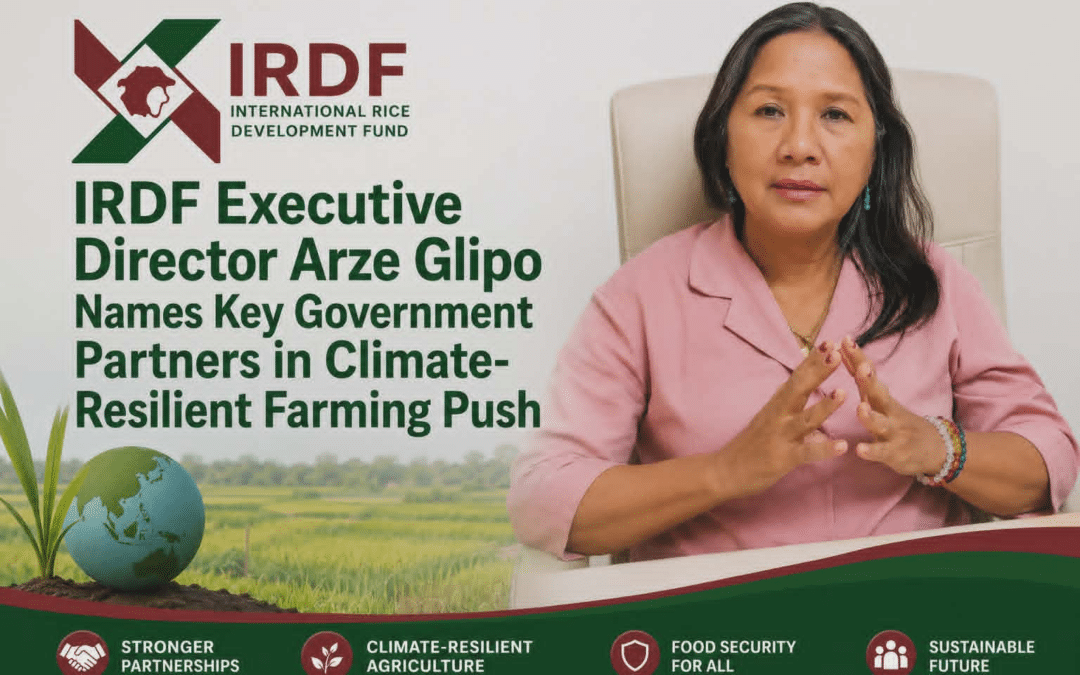
QUEZON CITY, Philippines – The Integrated Rural Development Foundation (IRDF) has identified several national government agencies as critical allies in its mission to build climate-resilient agricultural communities across the country, according to IRDF Executive Director Arze Glipo.
In an interview, Glipo detailed the foundation’s collaborative efforts with the Department of Agriculture (DA), Department of Science and Technology (DOST), Department of Trade and Industry (DTI), Department of Agrarian Reform (DAR), Department of Environment and Natural Resources (DENR), and the Bureau of Fisheries and Aquatic Resources (BFAR).
DA, DOST Help Farmers Adapt to Climate Risks
Glipo emphasized that the Department of Agriculture has been instrumental in advancing the foundation’s promotion of agroecology principles and diversified farming systems.
“So ngayon ang isang priority namin ay ang promotion ng agroecology principles and approach sa farming… Mas na-introduce namin yung mga diversified farming system, paggamit ng mga organic inputs, paggamit ng mga sistema ng pagsasaka tulad ng System of Rice Intensification (SRI) na mas malaki ang produksyon o ani ng palay sa maliit lang na paggamit ng mga inputs at resources at tubig,” Glipo said.
Under the DA’s climate change adaptation program, IRDF helps farmers develop tailor-fit strategies based on local climate risks. Farmers are trained to adjust cropping calendars to avoid typhoons and droughts.
“Ito ang mga halimbawa ng pag-asa. Nakakapaghanda ng tamang buwan ng pagsasaka… Nagkakaroon ng naiiwasan yung pagkasira ng kanilang mga ani dahil hindi na ito tumatama sa panahon ng may malalakas na bagyo,” the executive director added.
The Department of Science and Technology (DOST), through its weather bureau PAGASA, helps farmers determine optimal planting schedules. Glipo noted that DOST also fabricated an oil extracting machine for pili growers, enabling them to process pili pulp into oil and pili nuts into candies.
DTI Provides Machinery, Market Access
The Department of Trade and Industry (DTI) supports IRDF’s income diversification initiatives, particularly for women’s groups and cooperatives.
“Nakakapagbigay din yung DTI ng mga makinarya… Sa Mindanao, nakatulong din namin yung DTI lalo na sa mga coop na tinutulungan namin. Na facilitate din namin yung mga proposals sa DTI para mabigyan ng mga makinarya sa coconut husk processing. Mayroon din mga trucks under DTI na ibinibigay sa mga coop,” Glipo said.
Glipo also explained that IRDF assists farmers and fisherfolk organizations in preparing business plans and meeting key performance indicators for successful business operations.
Engaging DAR, DENR, BFAR on Land Rights, Environmental Justice
IRDF engages the Department of Agrarian Reform (DAR) and DENR on long-standing land tenure issues, including a case in Dingalan, Aurora, where farming families have lived and cultivated land within what is now a military reservation.
“Tinutulungan namin sila na makapag-dialogo sa DAR, Office of the President upang ipawalang bisa yung proclamation order na sumasakop sa kanilang sakahan bilang bahagi ng military reservation. Ito ay isang uphill battle pero dahil yung mga magsasaka ay naninindigan sa karapatan nila sa lupa, na kinikilala naman ng Saligang Batas, patuloy namin din itong sinusuportahan,” Glipo stated.
Building Resilient, Diversified Farm Economies
Beyond government partnerships, Glipo emphasized that IRDF helps farming communities build resilience through value-adding and processing. Farmers are trained to mill rice instead of selling only palay, and to develop diverse income sources not solely dependent on single crops vulnerable to typhoons or drought.
“Nagkakaroon ng diverse source of income dahil tinututukan namin ang value-adding at pagproseso, paglalagay ng halaga sa mga produkto… Yun ang example ng tinatawag namin na pagpapalakas ng resilience at pagbangon sa mga komunidad na naapektuhan ng climate change,” Glipo concluded.
Glipo also mentioned that IRDF partners with state universities such as Western Mindanao State University in Zamboanga to introduce agroforestry systems, intercropping with coconut, and carbon credit opportunities through tree planting.#