
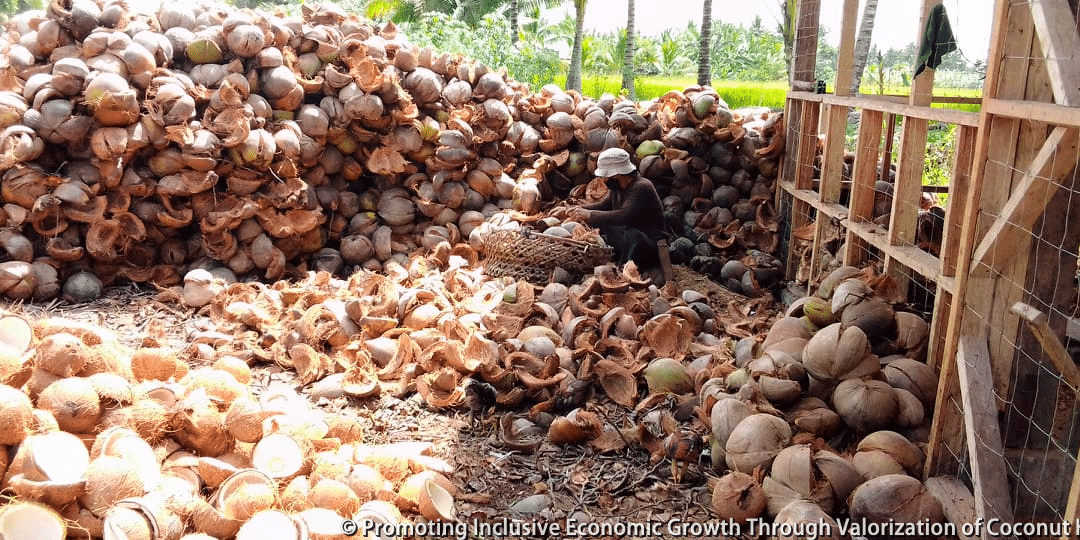
What was once discarded, burned or left to rot in coconut farms became the foundation of a new rural enterprise in Mindanao. Through a six-year partnership involving the Integrated Rural Development Foundation (IRDF), BIOGROW Philippines and farming communities, coconut husks were transformed into coco chips, coco peat, fiber, organic fertilizer and other marketable products—creating jobs, additional income and new skills while demonstrating how agricultural waste can become an economic resource.
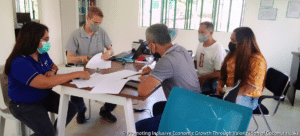
The project, “Promoting Inclusive Economic Growth Through Valorization of Coconut Husks,” ran from July 2019 to July 2025 under the Danida Market Development Partnerships framework. Its central idea was straightforward: connect coconut smallholder farmers with a commercial market and turn an abundant but underused farm by-product into valuable inputs for the horticulture industry.
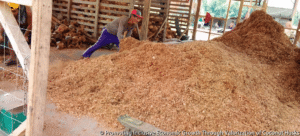
IRDF served as the administrative and community development partner, while BIOGROW became the key commercial partner. The initiative focused particularly on Magsaysay in Davao del Sur and Makilala and Kidapawan City in North Cotabato, where it sought to create sustainable employment and establish a viable coconut-husk value chain.
A simple idea with a bigger purpose
Coconut husks are often regarded as waste after the economically familiar parts of the coconut have been harvested. The project saw something different: a raw material waiting to be converted into higher-value products.
Through processing, husks could become coco chips, coco peat and fiber, which have uses in horticulture and agriculture. The project therefore sought not merely to dispose of agricultural waste, but to build a local industry around it. The original project concept envisioned sustainable employment for thousands of farmers and farmworkers, with particular attention to women and young people.
This brought together two goals that are sometimes treated separately: business development and rural development. BIOGROW provided the commercial link and processing market, while IRDF organized communities, developed farmers’ capabilities and helped build the local supply chain.
Thousands reached, hundreds of jobs created
By the project’s completion, the results extended well beyond the coconut husk itself.
According to the completion report, 540 jobs were created through the BIOGROW plant and the IRDF Demo Center, including jobs for 263 women and 92 young people. The report also recorded improved incomes among 3,882 male farmers, who earned from coconut husks, madre de cacao and other intercrops, averaging roughly ₱1,700 to ₱3,600 per farmer.
Another 962 women cooperative members generated income through activities including coco fiber, geonet, organic and liquid fertilizer production, nursery and seedling operations, and ornamental plants. Meanwhile, 420 young people earned additional income from selling seedlings and specialized coco-chip drying work.
These numbers illustrate one of the project’s important features: instead of depending on only one product or income source, rural households were given opportunities to participate in different stages of the coconut value chain.
Women and youth, in particular, could participate in smaller value-adding enterprises while farmers continued earning from husks and other farm products. The report says this diversification helped reduce the financial risks associated with relying on a single agricultural commodity.
Building skills, not just processing husks
The initiative also invested heavily in training.
The IRDF Demo Center trained 2,341 farmers who could supply coconut husks, while 751 young people received training in aging and drying coco-husk chips and 903 women were trained in coconut-husk processing and coco-fiber twining. Training also covered business planning, machine care and maintenance, enterprise development, chips aging and drying, and organic fertilizer production.
The Demo Center eventually became more than a production facility. By 2025, other cooperatives were visiting it for benchmarking and learning about processing techniques and business management—giving the project potential to serve as a model beyond its original communities.
From 5,000 to 18,000 husks a day
The project’s growth can also be seen in the volume of coconut waste it was able to process.
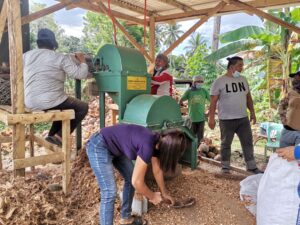
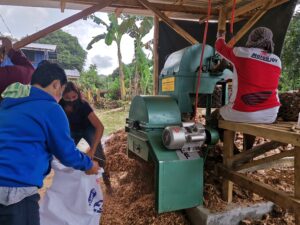
At the IRDF Demo Center, processing capacity increased from about 5,000 husks per day in 2022 to 18,000 husks per day by the end of the project in July 2025. From 2023 to 2025, the center processed more than 12.1 million coconut husks, producing about 60,554 cubic meters of fresh chips and selling 48,443 cubic meters of dried chips to BIOGROW and other markets. It also produced 18,640 sacks of coco peat and 2,752 sacks of organic fertilizer.
BIOGROW, meanwhile, established its production facility in Malalag, Davao del Sur, in 2021 and began operating in 2022 despite COVID-related restrictions. By 2023, production from BIOGROW and the project’s local supply network had helped support exports of approximately 24,000 cubic meters of coco chips, equivalent to 62 containers according to the report.
The products were intended not only for the Philippine market. BIOGROW’s horticultural substrates—including coco chips, coco peat and grow bags—serve export markets including China, Japan and Korea.
The road was not without setbacks
The project’s story, however, was not one of uninterrupted success.
IRDF initially helped organize 15 farmers’ associations and cooperatives as part of the planned coconut-chip supply network. But only four were able to install chipping machines, and just three sustained operations through the end of 2023. Those cooperatives eventually struggled to meet demanding requirements for aging and drying export-grade coconut chips.
Among the problems were insufficient working capital, machine-maintenance difficulties, manpower shortages and prolonged rainy weather, which made drying coconut chips especially difficult.
Instead of abandoning the initiative, the project changed course.
Beginning in 2024, greater responsibility for processing was shifted to the IRDF Demo Center, which had more capacity to control aging and drying and meet the required specifications. The center was subsequently prepared to evolve into an autonomous social enterprise.
There were further difficulties. Cash-flow constraints at the Demo Center and communication problems between IRDF and BIOGROW strained their relationship, eventually disrupting BIOGROW’s purchases from the center. The completion report identifies these experiences as important lessons on communication, realistic expectations for smallholder cooperatives, operational costs and fair pricing.
That experience underscored a larger lesson: a technically workable rural enterprise also needs adequate financing, fair commercial arrangements, strong communication and a realistic understanding of conditions faced by small farmers and cooperatives.
Today, the partnership continues to grow, with both parties sharing responsibilities for producing quality products. BIOGROW provides technical advice and training while adjusting its pricing arrangements to ensure that the enterprise and its workers receive a fairer share of the value they create.
An environmental solution as well as a livelihood
Beyond income, the project demonstrated a practical form of the circular economy.
Instead of allowing coconut husks to be burned or left to decompose, the project converted them into coco chips, peat and organic fertilizer. Organic fertilizer production and diversified farming were also added to the Demo Center’s activities, helping connect waste utilization with soil improvement and more sustainable agricultural practices.
The completion report describes the broader impact as a combination of economic, social and environmental gains: reduced agricultural waste, new livelihood opportunities, stronger rural enterprises, skills development among women and youth, and more environmentally responsible business practices.
A model that can outlive the project
Although DMDP funding ended, the project’s intended legacy goes beyond its formal six-year lifespan.
Its sustainability strategy centers on transforming the Demo Center into a self-sustaining social enterprise, diversifying markets and financing, and replicating production and training approaches developed during the project. The report says the skills, employment, environmental practices and institutional capacities created through the initiative have been embedded in local systems.
The original project concept described the initiative as an effort to turn an abundant but underutilized agricultural by-product into a new industrial ecosystem rooted in local agriculture. After six years of implementation, the experience offers a more nuanced lesson: transforming waste into wealth requires not only machines and markets, but also trained people, viable prices, reliable financing, adaptable institutions and lasting partnerships.
For Mindanao’s coconut communities, however, the project’s most tangible achievement may be the change in how something as ordinary as a discarded coconut husk is viewed. What once had little or no value can become a source of livelihood, enterprise and environmental benefit—when farmers, communities, development organizations and businesses are connected to the same value chain.#