
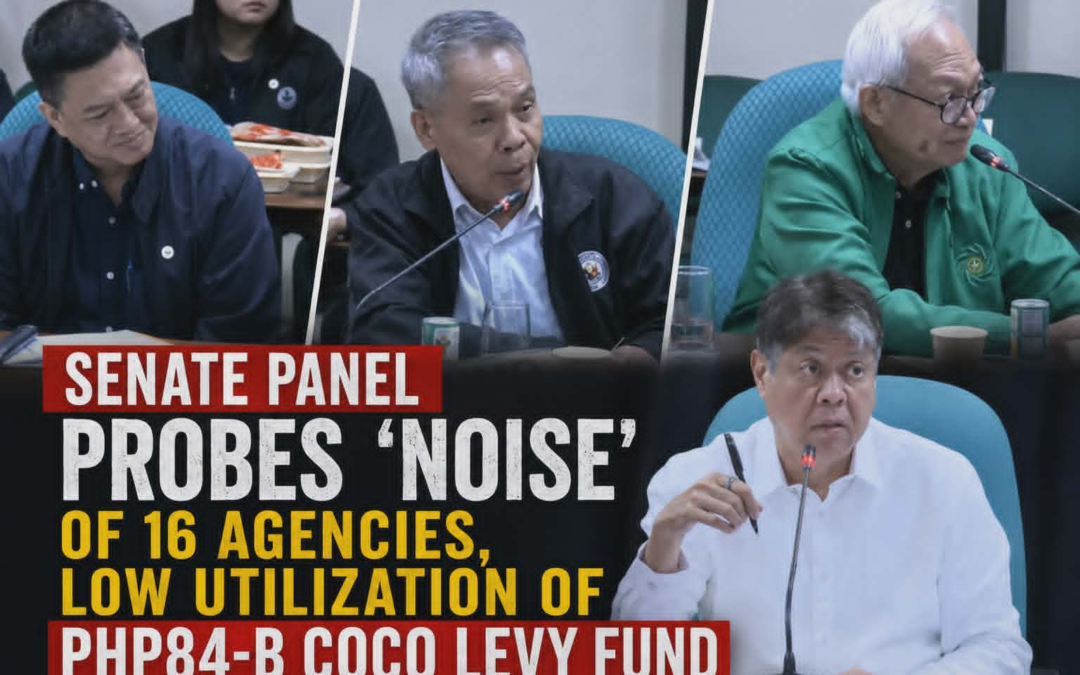
Quezon City, May 7, 2026 – The Senate Committee on Agriculture, Food, and Agrarian Reform, chaired by Senator Francis “Kiko” Pangilinan, conducted a hearing today to address the dismal state of the multi-billion peso Coconut Farmers and Industry Trust Fund (CFITF), five years after the passage of Republic Act 11524. The hearing revealed that while the fund has grown to Php84.68 billion, a fragmented implementation structure involving 16 different agencies has led to low fund utilization rates, slow disbursements, and a failure to significantly improve the lives of the nation’s poorest coconut farmers.
At the center of the discussion were proposed amendments to RA 11524, which aim to remove rigid, pre-determined budget allocations and strengthen the direct participation of coconut farmers in managing the fund that was collected from them through a levy since the 1970s.
‘A Conductor is Needed, Not 16 Solo Instruments’
The most striking analogy of the hearing came from Department of Agriculture (DA) Undersecretary Asis Perez, who described the current implementation of the law as chaotic and uncoordinated.
“It’s just like giving 14 different instruments to different players without a conductor… instead of bringing about music, it’s noise,” Perez told the committee, referring to the 16 implementing agencies mandated by the law. He and other resource persons, including Philippine Coconut Authority (PCA) Administrator Dr. Dexter Rueded, strongly advocated for amending the law to remove the fixed percentage allocations, allowing the fund to be spent based on a responsive and farmer-driven development plan.
The data presented to the committee underscored this point. Multiple agencies reported alarmingly low utilization rates of their allocated shares from 2022 to 2025:
- The Philippine Center for Postharvest Development and Mechanization (PhilMech) utilized only 9.29% of its Php2.05 billion allocation, citing misaligned procurement and infrastructure delays.
- The Department of Science and Technology (DOST-PCAARRD) utilized just 28% of its Php1.9 billion, primarily due to overly restrictive provisions limiting funds to hybridization research.
- The Department of Agriculture’s High-Value Crops program reported a 43% utilization rate.
- The National Dairy Authority (NDA) and the Bureau of Animal Industry (BAI) also reported significant underutilization, blaming issues ranging from failed biddings and importation bans to a lack of coordination and delayed fund releases.
Only the Philippine Crop Insurance Corporation (PCIC) reported a 100% utilization rate for its insurance programs for coconut farmers.
Php84 Billion and Farmers Earning Only Php200 a Day
The Bureau of the Treasury (BTR) reported that as of April 15, 2026, the Coco Levy Trust Fund holds Php78 billion in cash and Php6.68 billion in non-cash assets (like shares in San Miguel Corp. and United Coconut Chemicals, Inc.), for a total of Php84.68 billion. This money comes from the Coco Levy, a tax forcibly collected from coconut farmers starting in the 1970s.
Despite the billions in the fund, the plight of the coconut farmer remains dire. Senator Risa Hontiveros pointed out that while neighbors like Indonesia, Vietnam, and Thailand have advanced in scale and value creation, the Philippine coconut sector lags, with farmers earning an average of just Php200 per day, or about Php40,000 per year.
DA Usec. Perez confirmed this figure, noting it is heavily dependent on the fluctuating price of copra (dried coconut meat). Senator Pangilinan expressed his dismay: “Php200 a day is not even $2 a day… that is still way below minimum wage.”
‘Justice Long Overdue’: Farmers Demand a Seat at the Table
The hearing concluded with powerful testimonies from coconut farmer groups, who reminded the committee that the fund was built from their “sweat and blood.”
Gerry Bulatao, representing the group Kaisahan, and Eduardo Mora, a farmer from Quezon province, called for the law to revert to the original intent of Senator Pangilinan’s now-defunct SBN 52. Key demands from the private sector include:
- Direct Farmer Representation: The current Trust Fund Management Committee (TFMC) is composed only of fiscal agencies (DOF, DBM, DOJ). Farmers are excluded and demand a seat in decision-making.
- Stop Asset Disposal: Farmers and agencies like the PCGG urged a halt to the forced sale of Coco Levy assets (like the CIIF Oil Mills Group), arguing that these should be used in joint ventures or public-private partnerships to benefit the industry, not sold off cheaply.
- Simplify Access to Credit: Landbank reported it has only served 38,000 coconut farmers (less than 1% of the 2.5 million eligible) through its loan program. Farmers complained of overly stringent requirements for loans, with one farmer asking, “It’s our money. Why are you making it so hard for us to access?”
Next Steps: Suspended for Amendments
Senator Pangilinan, who noted he originally authored the measure but “voted with serious reservations” on the final version of RA 11524, ordered the hearing suspended. He directed all agencies and stakeholders to submit comprehensive position papers on the proposed amendments. The committee is eyeing a consolidated bill, which has been identified as a priority measure by the Executive department, to fix what many called a broken system.
“The struggle for the Coco Levy fund has been going on for more than four decades, and the struggle continues,” Pangilinan said in his opening statement. “This hearing is an opportunity to go back to the drawing board and ensure that the fund truly uplifts the lives of our coconut farmers.”#
(tuklasinnatin.net)