
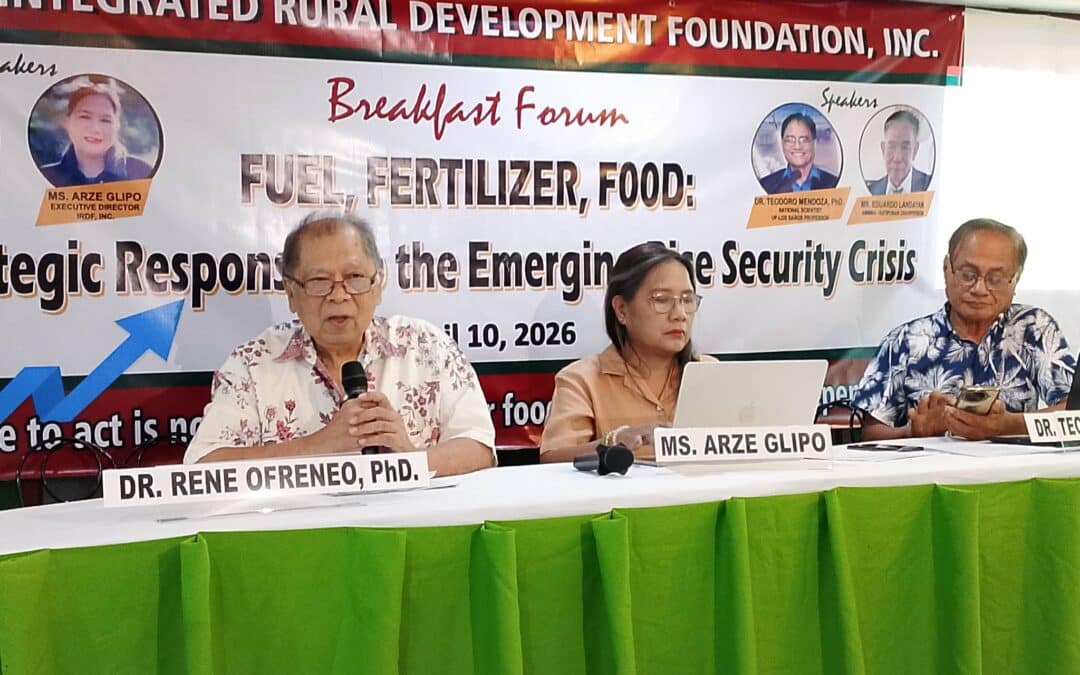
QUEZON CITY, PHILIPPINES —April 10, 2026 — As the Middle East conflict continues to destabilize global energy markets and fuel local rice prices toward a staggering ₱60–₱70 per kilogram, the Integrated Rural Development Foundation (IRDF) and its partner civil society organizations issued an urgent call for the Philippine government to pivot from “band-aid” solutions to a decisive National Survival Strategy, during a breakfast forum held at Kamuning Bakery, Quezon City today.
Risks to Philippine Food Security (Next 6 Months)
In the next six months, the Philippines faces serious risks to its food security owing to its 98% dependency on imported oil. Key risks include:
- Irrigation Collapse: With diesel prices now exceeding ₱130/liter, many farmers in non-irrigated areas are already cutting irrigation cycles from three to one, which will lead to significant yield drops in the upcoming harvest.
- Fertilizer Hyper-inflation: Urea prices have surged nearly 46% in early 2026. Farmers unable to afford these inputs will see “hidden hunger” in crops, leading to smaller grains and lower nutritional value.
- Logistics Bottlenecks: High transport costs and filling station closures (over 400 closed as of late March) are creating “food deserts” where food exists in the province but cannot affordably reach Metro Manila or major urban centers.
- Pest Outbreaks: PhilRice has warned of major threats from Brown Plant hoppers and Stem borers in the first half of 2026. Weakened plants (due to less fertilizer) are more susceptible to these infestations.
On top of this, there is a developing El Nino phenomenon by mid-2026 based on PAGASA’s forecast by mid‑2026, that could impact severely local production. Its March 2026 climate outlook confirms warming sea surface temperatures and suppressed rainfall patterns, with onset expected by June and persisting until late 2026.
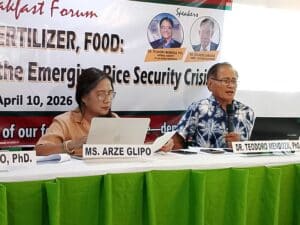
Prof. Teodoro Mendoza, a distinguished agronomist and retired professor from the UP Los Banos developed three scenarios indicating sharp fall in annual palay yield (with baseline yield of 20 million metric tons) at 45% reduction in less severe scenario, 55% reduction under moderate condition and 65% reduction under severe/worst-case scenario owing to severe effect of El Nino, high price of oil-based inputs and cost-cutting measures that maybe done by farmers. “Rice imports could range from 4.9 Mt, 5.8 Mt, 6.6 million Mt for less, moderate, to severe impacts of this triple crisis,” he added.
The country’s policy on import reliance given parallel risks in Thailand and Vietnam, India is disastrous.
IRDF warned that the current queues at NFA outlets and Kadiwa centers are not merely a logistical failure but reveals the beginning of a systemic food security collapse. To avert a full-scale famine in the coming six months, the IRDF outlines the following urgent and medium-term mandates:
URGENT ACTIONS: Immediate Relief for the Next 90 Days
Government need to act quickly combining price stabilization (through price ceilings on imported rice) with supply-side interventions (buffer stock release). The following are proposed urgent measures:
- Immediate Suspension of Oil Taxes: We demand the immediate suspension of excise taxes and VAT on fuel and petroleum-based fertilizers. With diesel now breaching ₱130/liter, this measure is the only way to lower production costs for farmers and prevent a total shutdown of the country’s transport and logistics chains.
- Expanded Cash Subsidies: We call for an immediate release of cash assistance of at least ₱10,000 per household for farmers, farmworkers, and informal urban workers, leveraging the ₱238 Billion consolidated crisis fund identified by the DBM. A target of 2 million rice farmers would need only PhP20 billion, only 10% of the crisis fund.
- Emergency “Quick Response” Fuel Vouchers: For the ongoing dry season harvest, immediately release the ₱1B QRF to provide fuel subsidies for mechanical harvesters and threshers to prevent post-harvest losses.
- Aggressive Rice Market Intervention: The NFA must immediately utilize its ₱16.6 Billion procurement budget to outbid private traders at the farm gate (buying at ₱25–₱28/kg) and flood the market with ₱45/kg milled rice through rolling stores in every municipality, not just Metro Manila. Increase its procurement fund to cover at least 15% of the total annual palay harvest.
- Enforce the ₱50 Price Cap on Imported Rice: Utilizing Executive Order 110, the government must strictly regulate importation. Landing costs are currently near $500/MT, a ₱50 cap prevents “panic pricing” at the retail level.
- Expansion of “Kadiwa on Wheels”: For NFA to work with coops, KADIWA centers and LGU’s to buy local palay at ₱25–₱28/kg and sell at ₱45/kg, absorbing the loss as a social safety net to break the ₱60/kg market trend.
- Establish a monitoring task force for enforcement and transparency. Enforce penalties against hoarding, profiteering and smuggling.
MEDIUM-TERM STRATEGIES: Decoupling Food from Oil
IRDF argues that to prevent a total systemic collapse, a dual strategy is required: To reduce the rice deficit, policy must combine supply-side resilience with demand-side adjustments.
The first set of policies should stabilize production through adoption of drought-resilient, short-duration rice varieties to mitigate El Niño impacts; expand irrigation efficiency via Solar-Powered Irrigation Systems (SPIS), rainwater harvesting and small reservoirs, promote bio-fertilizers and organic soil amendments to reduce dependence on oil-based inputs, and support farmer incentives for maintaining optimal fertilizer use despite rising costs.
Prof. Ted Mendoza recommends Dietary Shifts and Demand Diversification by promoting vegetable consumption, root crops as staple substitutes.
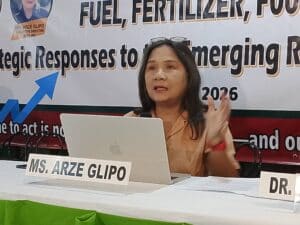
Arze Glipo, Executive Director of IRDF recommended repeal of the Rice Tarrification Law (RTL) so that the NFA can increase it rice buffer stock from the current 15-day mandated by the RTL to at least 60-day rice reserve. She added that government should actively intervene in trade and put effective price caps on inputs to impose ceilings on fertilizers and essential farm inputs to prevent profiteering during the energy crisis.
Dr. Rene Ofreneo, President of IRDF, renowned labor economist, academic and policy expert, identifies resources to fund these interventions that are already within the government’s reach. He cited the Malampaya Fund, currently holding over $13.9 Billion in total generated revenues, with ₱20 Billion already earmarked for emergency fuel procurement. He added that over ₱210 Billion from the 2025 and 2026 General Appropriations Act (GAA) has been identified for crisis response and there is approximately ₱100 Million in unspent fuel funds from 2023–2025 that should be immediately re-liquidated for the agriculture sector.
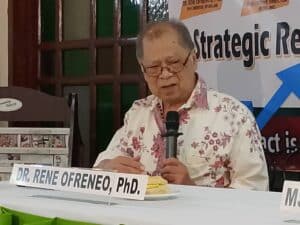
“Government must act decisively to prevent rising oil prices from becoming a full-blown rice and consumer crisis,” Dr. Ofreneo argued. “The government has the funds and the legal authority; what is missing is the political will to prioritize the stomachs of the poor over the revenues of the state.” # # #
About IRDF: The Integrated Rural Development Foundation (IRDF) is a non-governmental organization dedicated to promoting climate-resilient agriculture, enterprise development, and food sovereignty for farming and fishing communities across the Philippines.